
Evidence & Impact
Secondary D6 learners on average get a half to a full grade higher across all subjects. Primary D6 learners also make significant gains. Disadvantaged students benefit disproportionately.
Designed around what research says works - and around what schools can actually deliver
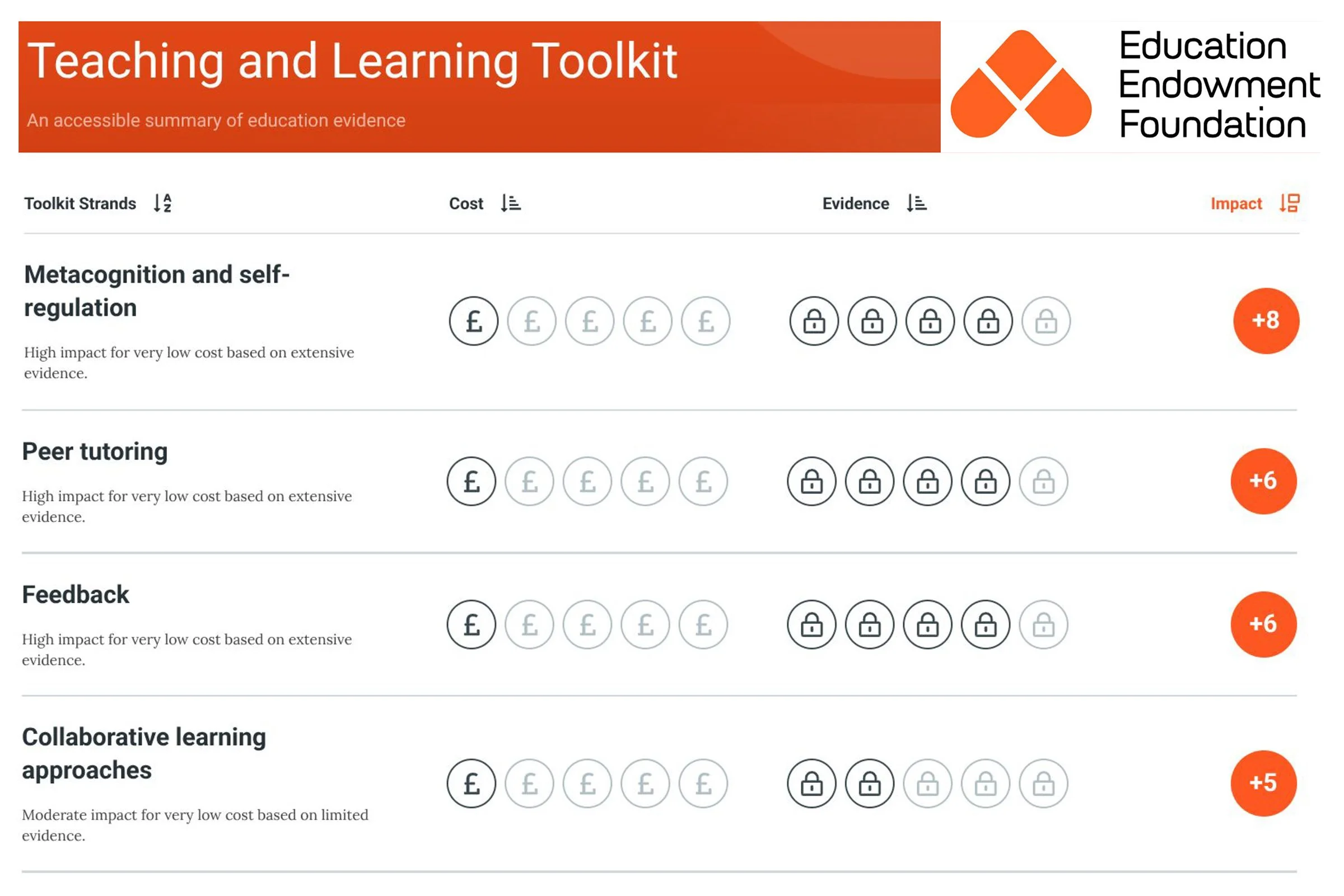
D6 wasn't developed by chance. It was deliberately designed around approaches with some of the strongest evidence bases identified by the Education Endowment Foundation Toolkit.
Rather than relying on a single intervention or a set of separate interventions, D6 combines several high-impact approaches into one coherent model:
Metacognition & Self-Regulation (+7 months)
Peer Tutoring (+6 months)
Feedback (+6 months)
Collaborative Learning (+5 months)
Social & Emotional Learning (+4 months)
The difference is not simply what D6 includes, but how it is delivered.
Rather than asking every teacher to change classroom practice (it doesn't ask teachers to do anything), D6 instead creates a different learning environment where these evidence-informed approaches flourish through learner agency, peer coaching and voluntary participation.
Secondary D6 - Impact and Outcomes
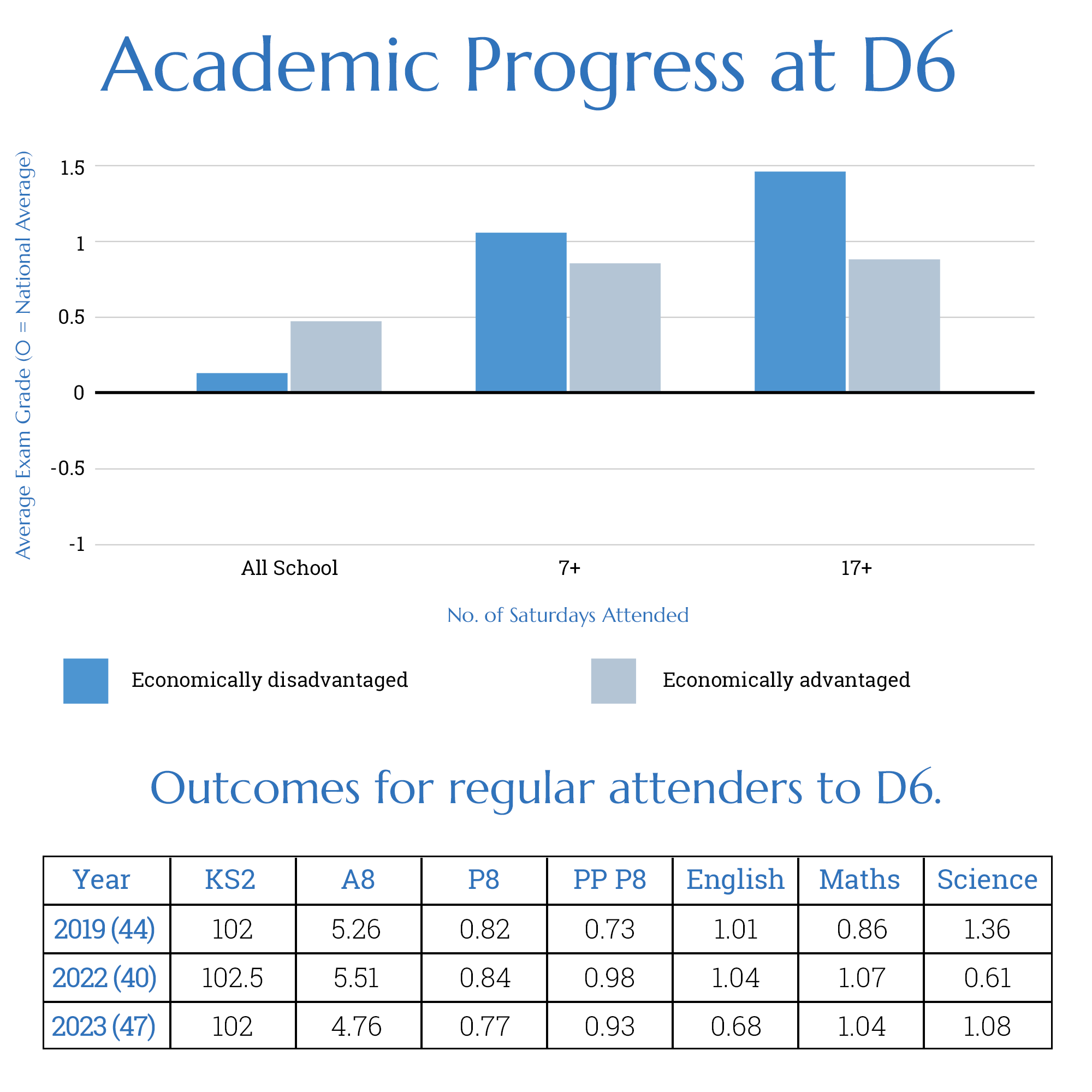
D6 has been successfully running and delivering improved outcomes for years across Watergrove secondary schools and some others locally.
The available data shows that participating D6 learners on average got a half to a full grade higher across all subjects. Disadvantaged learners and low prior attainers benefit disproportionately. Progress 8 scores for PP learners are regularly around above 1, especially for those regularly attending. One year the progress score for looked after children exceeded 2.0.
Students also report a wider range of benefits with attendance, motivation, aspiration and confidence.
*All figures relate to Matthew Moss High School in 2023 unless otherwise stated.
Primary D6 - Impact and Outcomes
Primary D6 was piloted during 2024/25 before expanding across all Watergrove primary schools.
The early evidence is extremely positive.
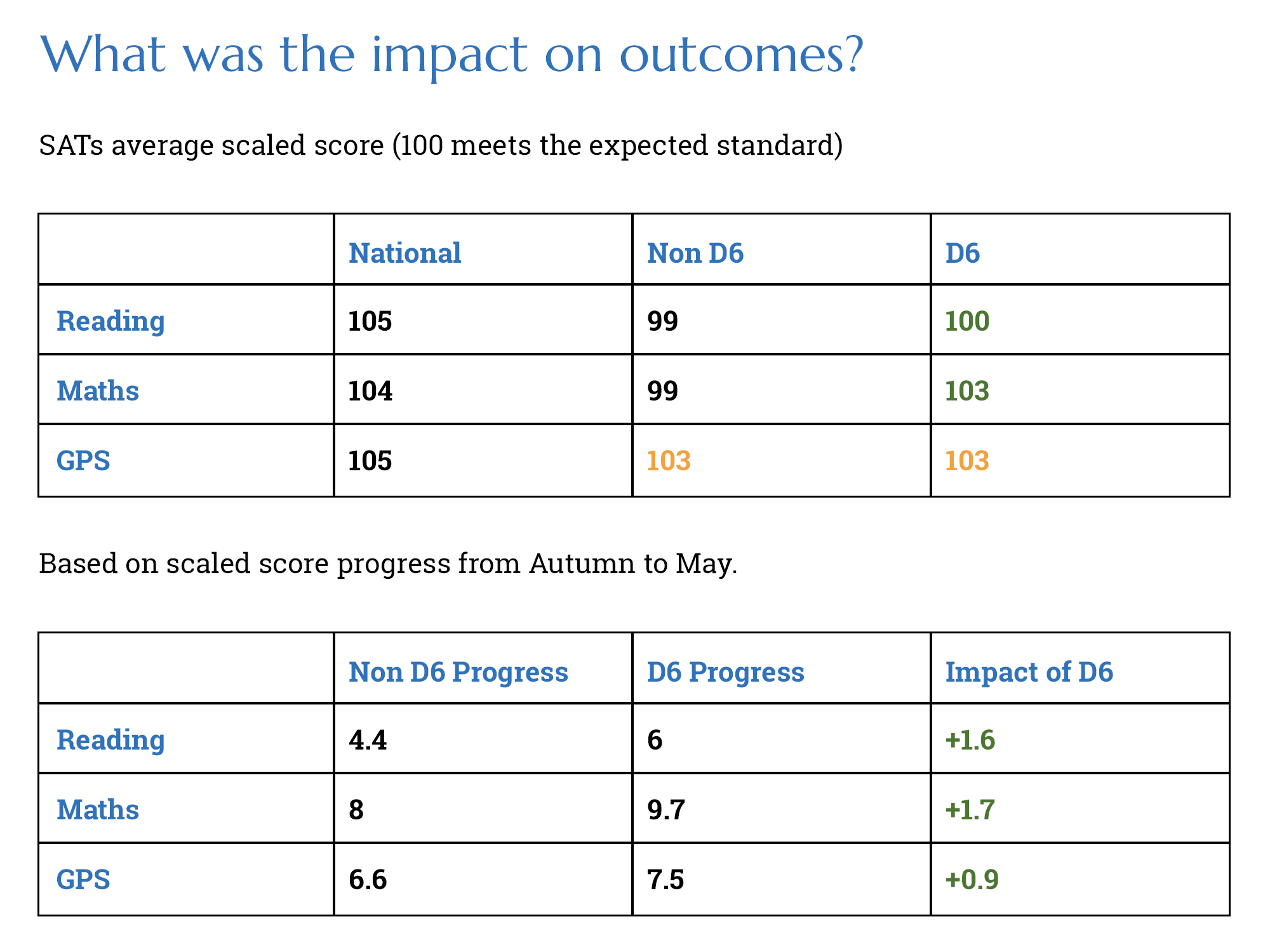
Compared with similar pupils:
• Reading improved by around 1.6 points.
• Maths improved by around 1.7 points.
• Learners reported significantly greater confidence about moving to secondary school.
Teachers and parents also described noticeable improvements in confidence, motivation and enthusiasm for learning.
Whilst these are early findings, they provide encouraging evidence that the D6 model transfers successfully into Key Stage 2.
Learners
Academic outcomes
Learner agency
Confidence
Attendance
Aspiration
Wellbeing
Independent learning
Transition
Coaches
Leadership
Communication
Coaching skills
Personal development
UCAS / CV
Paid employment
D6
Schools
Improved outcomes
Stronger inclusion
Monday - Friday impact
Staff capacity
Cross-phase collaboration
Communities
Parental engagement
Relationships
Social cohesion
Local partnerships
Wider Benefits
Whilst academic progress is central, D6 creates benefits that reach far beyond examination results.
Learners develop greater confidence, independence, aspiration and study habits. Attendance improves. Coaches gain employment and develop leadership and coaching skills. Schools strengthen relationships across year groups and between primary and secondary phases. Parents become more engaged and communities become more connected.Teachers benefit from improved engagement Monday to Friday.
This broader impact is one reason schools continue to expand D6 once they have experienced it. It is not simply an intervention; it becomes part of a school's culture.
Interested in finding out more?
We would be glad to talk. Initial conversations are informal, with no expectation that schools commit to anything.
D6 is developed by Watergrove Trust and is open to schools and trusts across a range of contexts.